Digital story telling. View from a massage table.
Come on. Dim the lights. Bring out the aromatherapy candles. Play some soothing Thai spa music. Lower the volume just a bit. Oh yeah!
I can barely see the warm tubs of oils, hot stones, moist towels, the steam rising. Not to let my mind wander though. I am at work. Need to complete a strategy note by EOD.
You know why I am advertising, don’t you? It’s mid-afternoon, I am lying on a couch in a posh spa getting pampered. The Mad Men days may be over for our business. And anyway, I am a digital guy.
I am putting together a strategy presentation for a new client. And I am soaking it in, the brand experience. Exploring options, feeling the stuff, poking, prodding and getting my thoughts ready.
As the masseur’s trained fingers run up and down my back tickling out hidden knots and pockets of stress, I am thinking of the brand story. A spine, as it were, around which this luxury spa brand will unravel it’s POV to the world.
Ah! I love my job.
The client will see no numbers, click thru rates, fan counts and such in this presentation. This is higher order stuff. The foundation of a brand, built around its brand story, its truth.
What’s the big deal, you may ask. Any good advertising person is supposed to experience a brand, live the experience, use the product and come up with a POV. What’s new?
Well, digital needs brands to be richer. Offer multi-layered story lines that get played out depending on the channel that is being used. More importantly, since brands can own media platforms on the digital channels they operate in, they can tell longer, more detailed stories unlike with traditional media, where they are constrained by sizes or time limits.
So how is this story coming along? Let’s for argument sake call the spa at home brand “Soul” and imagine that I am putting together this multilayered brand story document for them.
Let me begin with the brand proposition. Soul. Luxury spa at home. Hmm nice. Looks like new territory for me. I begin to construct the brand’s story.
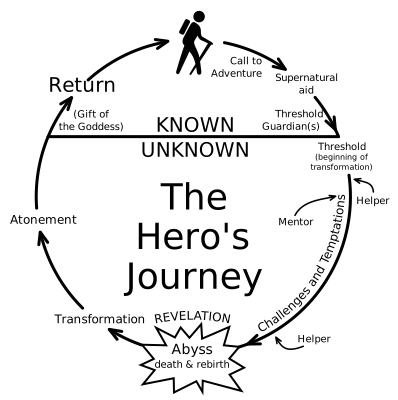
If you have, like me, been lucky enough to interact with a smart lady called Story Ninja you too would have learnt a few things about stories. The theory around stories. About concepts like the Monomyth and The Heroes’ Journey as propounded by Joseph Campbell. In conversations with Story Ninja I have come to learn that there are basic patterns that can be found in all universal stories. And as I construct a digital strategy for Soul, I dive in to build a compelling, multi-dimensional narrative that can make deep connections with people.
Additionally, I reach out to the teachings of former MIT Professor Henry Jenkins and his wonderful approach called Transmedia Storytelling. Or, how in today’s world with multiple digital and traditional media platforms stories can play out differently, across these platforms and yet create a powerful and unified whole as the participants in these stories (people) put them together. Advertising planner Faris Yakob has taken this thinking and furthered it for use in advertising, which he calls Transmedia Planning.
So as I think of the brand story for Soul I am constructing a simple, universal narrative from within the Heroes’ Journey and then use transmedia planning to play it out to the world.
I can’t disclose the brand story that is coming alive in my mind (NDA and stuff my friends) but I can share the platform thinking. From the company’s website, to the many digital and social media channels that are available to brands these days. YouTube, Facebook, Twitter, Blogger, 43 Things, Instagram, Pinterest, Linkedin. Throw in a porn site even, YouPorn, why not? For a brand that makes massage oil, let’s have some sensual “how to” videos up there too.
Told you, love my job…
So I can see the streams coming together. Soul: Luxury Spa at home, if that is the proposition. Unlike a traditional advertising, where I will be constrained by ad sizes or spot time limits, I can think free. Have long sensuous videos play out on video sites. Seed them across the web using Facebook and Twitter. Build a good profile of the company using a smart website to help Soul come across as a solid and reliable brand. Talk about individual products and their secrets using blog posts. Show beautiful images of Soul products and how they can be used, on Instagram and Pinterest. Build the reputation of people behind the company on Linkedin. Cross link stuff around so I can optimize the company’s site for search engines. Sweet! I can see this working on me. Not the massage, silly! The startegy.
Apart from the cost of building the Soul website and some monies incurred in production, I have not spent a dime in media costs. So while historically a brand would have a 90:10 split between media and production, all that Soul is incurring is in production costs, and of course the fat fees they pay me for helping them get their digital act together.
So before I doze off, and if you are still with me, here are the take outs. In the world of digital brand building, we need to imagine richer, multilayered brand stories. While executing these stories don’t worry about space and time constraints. Instead think platforms. So what you do on YouTube need not be what you will do on Pinterest. Each platform has a grammar of its own. Consider that when building brand stories. People who are on these platforms expect a certain behavior from others around. So instead of thinking traditionally and narrow casting your brand around one line, or around a slogan, think wider. Think richer.
Finally. There are a few kits of Soul that my client wants to give away. Would you like to receive one? Post a comment below and I will reach out to you. Brands in the digital world are all about giving.
 Alternative marketing thinking